Read how the musical was written and staged, then follow it song by song. The full plot opens only when you choose.
LONDON, 1985 · BEHIND THE SUCCESS STORY
Every beginning is difficult
A bruising London reception. A different story at the box office.
On 8 October 1985, the English-language Les Misérables opened at London’s Barbican, presented by Cameron Mackintosh and the Royal Shakespeare Company. Today it is difficult to imagine musical theatre without it; then, its future was still unwritten. The official study guide describes the reviews as mostly poor.
Then came the telephone call to the box office. The guide recounts how a discouraged Mackintosh called and found a very busy ticket seller, with phones ringing constantly. While the critics hesitated, audiences wanted seats. Word of mouth spread, and the musical began finding its future among the people in the auditorium.
Less than two months later, on 4 December 1985, the production moved to the Palace Theatre in the West End. In 1987, the Broadway production won eight Tony Awards, including Best Musical. Audiences were already helping write a different story from the one suggested by those early reviews.
What actually bothered the critics?
Behind the sharp one-liners were questions about character, music and the power of the scenery. These were some of the objections in London in 1985 and, later, on Broadway in 1987.
London · 10 October 1985
When the characters felt thin
Michael Billington · The Guardian
Billington found depth missing from the cartoon-like characters. Alun Armstrong and Roger Allam were exceptions: their performances gave Thénardier and Javert individuality he did not consistently find in the writing. An excerpt survives on Allam’s official website.
MacKenzie described a show that asked audiences to admire it rather than like it. Her distinction questions the production’s imposing sense of importance. Revisiting her response in 2020, Time Out stressed that the original reviews were mixed.
Oliver admired the design but felt the effects diminished the characters. Even the best songs struck her as immediately forgettable. Visual astonishment and dramatic dissatisfaction could coexist.
Five years before London: the French concept album appeared in 1980, followed that September by Robert Hossein’s production at the Palais des Sports in Paris. That beginning grew into the expanded English version whose London opening caused such a stir.
Choose a song. Listen closer, compare performances, and open its place in the story only when you want the plot.
♫
Éponine’s solo
On My Own
On My Own gives Éponine, a young woman living on Paris’s margins, a solo spotlight. The English words are Herbert Kretzmer’s, set to Claude-Michel Schönberg’s music: two distinct contributions to the voice we hear.
Where the sentence changes direction
The melody gives Éponine long phrases in which to develop a picture. The words also keep correcting that picture. Follow the turns within a phrase: a singer can let the sound bloom, then give a small word enough emphasis to undo the reassurance. The later, stronger singing works best when the thought remains legible through it. Volume alone cannot tell us whether she is enjoying an image, arguing with herself or admitting something difficult.
A listening experiment to try
Compare the turn, not the timestamp
Choose the passage where a pleasant imagined scene gives way to a less comfortable admission. In two performances, notice how long the singer lets the picture last. Does the change arrive on a breath, in a consonant or with a different vocal colour? English and Hebrew may place that emphasis differently, so compare the completed thought rather than the same second on the player.
How does the singer move between inward thought and a more open sound?
Pointers for listening and thinking
Ideas to test, not a single answer. Listen first if you like, then open these.
Choose a quiet phrase and a more open one. Listen to vowel length, word endings and breathing space, not only volume.
An expanding voice can suggest a thought that is becoming hard to keep inside. In another performance it may sound like an effort to hold the feeling together.
Find the same phrase in another performance: does the turning point move, and does that change how you understand Éponine?
The plot context and links between scenes stay behind the spoiler warning.
The interval follows One Day More. Lengths and connective material can vary between versions and productions.
03
38 stops to listen through
Major songs, transitions and reprises, with context and listening questions.
CHOOSE AN EVENING WITH THE MUSIC
Which Les Mis fits your evening?
Meet the performers, compare editions, then choose an audio album, a filmed concert or the movie. The new fortieth-anniversary album is included below.
Colm Wilkinson · Philip Quast · Lea Salonga · Michael Ball
For hearing these four voices together with the Royal Philharmonic Orchestra, in the concert marking ten years of the London production.
Linked format: Audio album · 41 tracks
About this performance · listening notes and sources
Recorded at the Royal Albert Hall on 8 October 1995, this anniversary concert brings together Colm Wilkinson, Philip Quast, Ruthie Henshall, Lea Salonga and Michael Ball with the Royal Philharmonic Orchestra. Compare Wilkinson’s “Bring Him Home”, Quast’s “Stars” and Henshall’s “I Dreamed a Dream”: where does each singer sustain a phrase, interrupt it for a breath, or stress a particular word?
The Apple link below opens the concert’s audio album: 41 tracks and about 2 hours 21 minutes of music, catalogued as a 1996 release. The concert was also filmed; this link is for listening. It can serve as a reference when comparing the same roles in the later anniversary concerts.
A question to take along
Try one familiar song here, then return to a later concert. What changes in the phrasing?
Pointers for listening and thinking
Ideas to test, not a single answer. Listen first if you like, then open these.
Choose one phrase and compare where each singer breathes, which word they lengthen and how they finish it.
A breath within a thought can suggest hesitation or effort; an unbroken phrase can sound determined. The context helps you decide what convinces you.
Compare the same passage in both concerts at a similar listening level. A difference in mixing or amplification can be mistaken for a difference in acting.
Follow a solo voice as the ensemble joins it, then try the same passage with another singer in mind.
Linked format: DVD video · Region 1
About this performance · listening notes and sources
The O2 anniversary puts Alfie Boe’s Jean Valjean opposite Norm Lewis’s Javert, with Lea Salonga as Fantine, Samantha Barks as Éponine, Nick Jonas as Marius and Ramin Karimloo as Enjolras. It also brings together performers from the Queen’s Theatre production, the anniversary production at the Barbican and the original 1985 London company. The result is a meeting between several generations of the show.
During “One Day More”, follow one voice as the other parts join it, then repeat the number with another character in mind. Can you still follow that voice when the camera cuts to somebody else? The purchase below is the filmed concert on DVD.
A question to take along
During an ensemble number, follow one singer before taking in the whole stage.
Pointers for listening and thinking
Ideas to test, not a single answer. Listen first if you like, then open these.
Pick one singer in an ensemble passage, then follow their voice as others join. When is it easy to identify and when is it difficult?
A voice blending into the group may create belonging; one standing out may keep a private wish in focus. Either can serve the scene.
On a second viewing, take in the whole stage. Does the camera direct you to the person who caught your ear, or to someone else?
Alfie Boe · Michael Ball · Carrie Hope Fletcher · Matt Lucas
For a concert inside a West End theatre. The Gielgud recording places the cast and orchestra together in a theatrical setting.
Linked format: Filmed staged concert
About this performance · listening notes and sources
The Gielgud Theatre recording pairs Alfie Boe as Valjean with Michael Ball as Javert, alongside Carrie Hope Fletcher’s Fantine and Matt Lucas’s Thénardier. More than 65 performers and musicians share the West End concert setting, with the cast and orchestra visible together. Watch how the performers address one another within that concert arrangement.
It is also a useful companion to the 2010 concert because Boe returns to the same leading role with different performers around him. Compare a phrase, a pause or the exchange between Valjean and Javert to discover different vocal and acting choices. This filmed performance is from 2019; some home-video listings carry its 2020 release date.
A question to take along
Notice what a glance or a small movement adds while another performer sings.
Pointers for listening and thinking
Ideas to test, not a single answer. Listen first if you like, then open these.
Choose a moment when one character sings and another is in frame. Check whether a glance, posture or small movement changes their relationship.
A silent response may suggest agreement, withdrawal or waiting for a turn. Keep more than one possibility open before returning to the words.
Listen without the picture, then watch. Which extra information came from the acting, and which was already in the voice?
Hugh Jackman · Russell Crowe · Anne Hathaway · Eddie Redmayne
For following the story through cinema: locations, editing and close-ups give the songs another frame.
Linked format: Musical film · Hebrew subtitles listed
About this performance · listening notes and sources
Tom Hooper’s screen adaptation stars Hugh Jackman as Valjean, Russell Crowe as Javert and Anne Hathaway as Fantine, with Eddie Redmayne as Marius. The camera can hold on a face during a solo or cut to the person listening. Compare those choices with a filmed concert: which reactions does each version show, and which does it leave outside the frame?
The singing was recorded live on set. Production sound mixer Simon Hayes describes an off-camera pianist following the actors and feeding accompaniment to their earpieces, allowing the timing to grow from the performance. Listen for how a breath or hesitation shapes a musical phrase, then compare the same passage with a concert recording. The linked Israeli Apple edition lists Hebrew subtitles.
A question to take along
Compare a film close-up with a concert performance. Where does each direct your attention?
Pointers for listening and thinking
Ideas to test, not a single answer. Listen first if you like, then open these.
Compare the same phrase in a close-up and a concert. What catches you first: breath, facial expression, movement or the sound itself?
A close-up can draw us toward a small detail; a wider view can reveal relationships. Neither has to feel more intimate or more truthful.
Check whether the detail that caught you comes from the performer or from camera and editing choices. Try describing the two contributions separately.
Gary Morris · Philip Quast · Debbie Byrne · Michael Ball
For following the musical by ear, including the passages between the big songs. The linked full album has 44 tracks.
Linked format: Complete audio album · 44 tracks
About this performance · listening notes and sources
This English-language album brings together an international cast including Gary Morris, Philip Quast, Debbie Byrne and Michael Ball. The full edition has 44 tracks and runs about 2 hours 48 minutes, taking in the musical connections between the familiar songs. It is especially useful for following the score as a continuous narrative and hearing how one scene hands the story to the next.
Listen with the song journey open, or let the voices and orchestration build the scene without a screen. Pay attention to recurring musical ideas and to changes of speaker inside a track. The links here lead to the complete album, distinct from its shorter “Highlights” edition. Its recording year is 1988, even when a service displays the date of a later reissue.
A question to take along
Listen to how one scene moves into the next. What tells you that the setting or speaker has changed?
Pointers for listening and thinking
Ideas to test, not a single answer. Listen first if you like, then open these.
At a scene transition, listen for a change in speaker, pace, a prominent instrument or the density of the accompaniment. Which signal arrives first?
An unbroken transition can connect events as though one pushes the next forward. A pause may suggest that a different place or time has begun.
Listen across a track boundary. Does the dramatic change happen exactly there, or does the music make the transition gradually?
About this performance · listening notes and sources
The fortieth anniversary also produced a new recording, bringing together voices from the London production and the Arena Spectacular. Killian Donnelly’s Valjean and Bradley Jaden’s Javert lead a 43-track album running about two and a half hours. Here the attraction is the company working through the score together: a new sonic portrait of the musical, rather than an audio souvenir of the October charity gala.
Katie Hall sings Fantine, Shan Ako is Éponine, Jac Yarrow is Marius and Beatrice Penny-Touré is Cosette. James D. Gish sings Enjolras, with Adam Gillen and Marina Prior as the Thénardiers. The date on a streaming service can be misleading when browsing anniversaries: Warner also reissued the 1995 concert in October 2025. That older performance and this newly released fortieth-anniversary album are different recordings.
A question to take along
How do Donnelly and Jaden change your sense of Valjean and Javert beside the earlier anniversary casts?
Earlier options checked 12 October 2026; the 2026 album added and checked 18 October. Each option identifies its format and provider; availability depends on your country.
How it beganFrom the earliest writing to the stage, with context and the creative notebook.
+
01
1862: the novel
Novelist Victor Hugo published Les Misérables in 1862. His characters and story were later adapted for musical theatre by co-writer Alain Boublil and composer and co-writer Claude-Michel Schönberg.
Robert Hossein directed the original French stage production at the Palais des Sports in Paris in September 1980. That production preceded the English-language version by five years.
04
8 October 1985: the English version
The reworked English-language version opened at London's Barbican on 8 October 1985, presented by Cameron Mackintosh and the Royal Shakespeare Company. Trevor Nunn and John Caird directed it; Herbert Kretzmer supplied the English lyrics, with additional material credited to James Fenton.
The English production transferred to the Palace Theatre on 4 December 1985. The 1980 French premiere and the 1985 London opening therefore mark different stages in the musical's creation.
Before the world knew the songs
In Stage by Stage, the makers look back at the working decisions, large and small, behind the journey from Paris to London.
Paris’s curtain falls
Paris’s first run ended because of a prior venue booking.
Paul Henry’s 1988 documentary Stage by Stage goes behind the musical’s writing, recording and staging. The linked upload by ארכיוניר 2 המחודש is from 2025; the film dates from 1988.
Claude-Michel Schönberg composed the music and co-wrote the book, the musical’s dramatic text, with Alain Boublil. The original French text is credited to Boublil and Jean-Marc Natel; Herbert Kretzmer wrote the English lyrics, with additional material credited to James Fenton.
In a 2015 interview for PRS for Music, Kretzmer described starting from each song’s idea and finding fresh English words for it. Expanding from roughly two hours in French to three in English also required new dramatic material, including songs such as Stars and Bring Him Home. Years later, he was still arguing with one of his rhymes in On My Own. It fitted the thought he wanted to express, but other writers had used it before.
Before his stage successes, Schönberg worked in France as a pop singer, songwriter and record producer. Boublil conceived Les Misérables as a musical and developed it with him.
The singing carries the action
Les Misérables is a sung-through musical: music carries exchanges and transitions as well as the major solos. Listen beyond the famous numbers to hear how the scenes connect.
The spark came from another musical
The official study guide traces Boublil’s inspiration to Oliver!: the Artful Dodger suggested a singing Gavroche. A child’s part in one musical helped him imagine how Hugo’s street boy could work on stage.
For the 2009–10 tour directed by Laurence Connor and James Powell, Matt Kinley’s design and 59’s projections drew on Hugo’s paintings and drawings. Kinley describes combining them, sometimes with nineteenth-century French photographs, in projections and using the artwork as a basis for painted cloths.
His account explains a practical choice: projections locate the many scenes, with most images kept simple rather than continuously animated. When watching this production, distinguish what changes in the projected image from what the actors and physical scenery do.
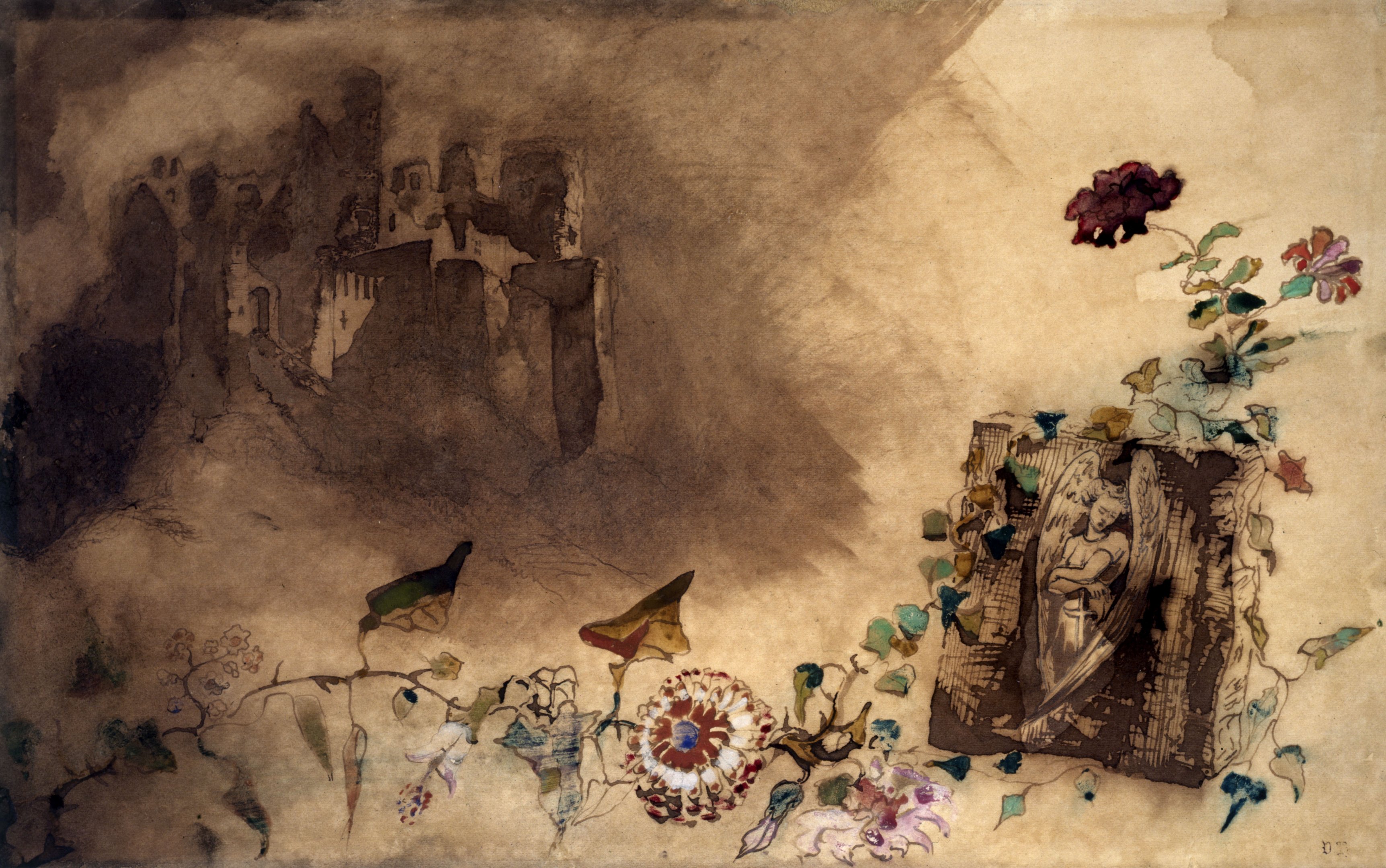
LOOK CLOSELY · HUGO THE ARTIST
From ink to stage light
An example of Hugo’s visual imagination. Le burg à l’ange, c. 1863. CC0 Paris Musées / Maisons de Victor Hugo Paris-Guernesey. · CC0 1.0 (opens in a new tab)
Castle, angel and flowers
The castle at left is built from broad brown washes; the angel at lower right has sharply drawn wings, folded arms and a cross on its robe. Coloured flowers run across the foreground and climb around the figure. Compare the edges: where does the ink blur into the paper, and where does a fine line define an object?
Who made the musical?Composers, writers and theatre-makers: the people behind the work.
+
01
Alain Boublil
Co-writer of the book; co-writer of the original French text
Boublil conceived the musical adaptation of Les Misérables and developed it with composer Claude-Michel Schönberg. Their other collaborations include Miss Saigon, Martin Guerre and The Pirate Queen.
02
Claude-Michel Schönberg
Composer; co-writer of the book
Schönberg began in French popular music as a singer, songwriter and record producer. With Boublil, he created the scores and co-wrote the books of Les Misérables, Miss Saigon and other musicals.
03
Jean-Marc Natel
Co-writer of the original French text
Natel studied visual art in Toulon before turning to poetry. After moving to Paris in 1968, he met Boublil and entered songwriting through their collaboration on Les Misérables.
04
Herbert Kretzmer
English lyrics
Born in South Africa, Kretzmer moved to London in 1954 and pursued journalism alongside songwriting. His work with Charles Aznavour included the English-language songs She and Yesterday When I Was Young.
05
Trevor Nunn
Co-adapter and original English-production co-director
Nunn led the Royal Shakespeare Company from 1968 to 1986 and later directed Britain's National Theatre. His musical-theatre work also includes the original productions of Cats and Starlight Express.
Co-adapter and original English-production co-director
Caird is a writer and director working across plays, opera and musical theatre. He is also the author of Theatre Craft, a practical book for directors published in 2010.
Fenton is a poet, journalist and writer for the stage. He served as Oxford's Professor of Poetry from 1994 to 1999 and has written plays, translations and opera libretti.
08
Cameron Mackintosh
Producer of the English-language production
Mackintosh has produced theatre since 1967, with credits including Cats, The Phantom of the Opera and Miss Saigon. He also produced the 2012 film adaptation of Les Misérables with Working Title and Universal.
Hugo (1802–1885) wrote novels, poetry and plays, including The Hunchback of Notre Dame. Les Misérables appeared in 1862, during his long political exile from France.
Director of the original French stage production (1980)
Hossein was a filmmaker who directed the first French staging of Les Misérables. His Paris production played more than 100 performances at the Palais des Sports in 1980.
11
James Powell & Laurence Connor
Directors of the new 25th-anniversary production (2009)
Powell and Connor directed the new staging first presented in 2009 for the musical's 25th anniversary. Their work also includes the anniversary concert at London's O2 in 2010.